Introducing Pictures: An AI-Powered Gallery for Photographers
Project Link: haozheli.pictures
Overview
Photographers often need a platform to systematically showcase their work. However, as their portfolio grows, traditional retrieval and recommendation methods become inefficient and cumbersome. As a creator, you want your audience to see the works that truly interest them, not get lost in countless images.
Pictures was created for that very reason.
By leveraging multimodal AI technology, this project enables a cross-language, cross-modality natural language search experience. Whether starting from an image or a short description, users can quickly find the most semantically relevant photography in the Gallery—ensuring that every piece truly gets seen.
Roadmap
- [ ] Advanced Search: Add filters for date ranges, precise keyword matching, and adjustable RRF weights (enabling image-only or text-only search tuning).
- [ ] Dynamic Homepage: Replace the static database scroll with personalized suggestions. While simple to implement on the backend, ensuring low latency with cached results remains a challenge.
Key Features
The following features make Pictures stand apart from traditional photo showcase websites.
Natural Language Search
In Pictures, simply type a short description into the search bar. The system understands your intent and finds the most relevant works.
No more worrying about “precise keywords”—our AI understands semantics and supports fuzzy matching to return the best results.
The search function also natively supports multilingual input, completely removing language barriers.
Image-to-Image Search
If you’re particularly fond of a photo, image-to-image search helps you discover more similar masterpieces.
Click “Find Similar,” and the system automatically retrieves and returns photos that are most visually and semantically similar—no manual input needed.
Random Recommendations
Looking for inspiration? Try Random Recommendations.
Our recommendation system intelligently curates photography that aligns with your tastes, making discovery effortless and enjoyable.
Technical Details
Pictures combines multiple cutting-edge technologies to deliver a high-quality, low-latency search and recommendation experience.
Hybrid Embedding and Hybrid Retrieval
This project adopts a hybrid embedding and hybrid retrieval strategy.
The core idea: represent and understand each image in multiple ways, then combine results from different perspectives during search.
The overall process is as follows:
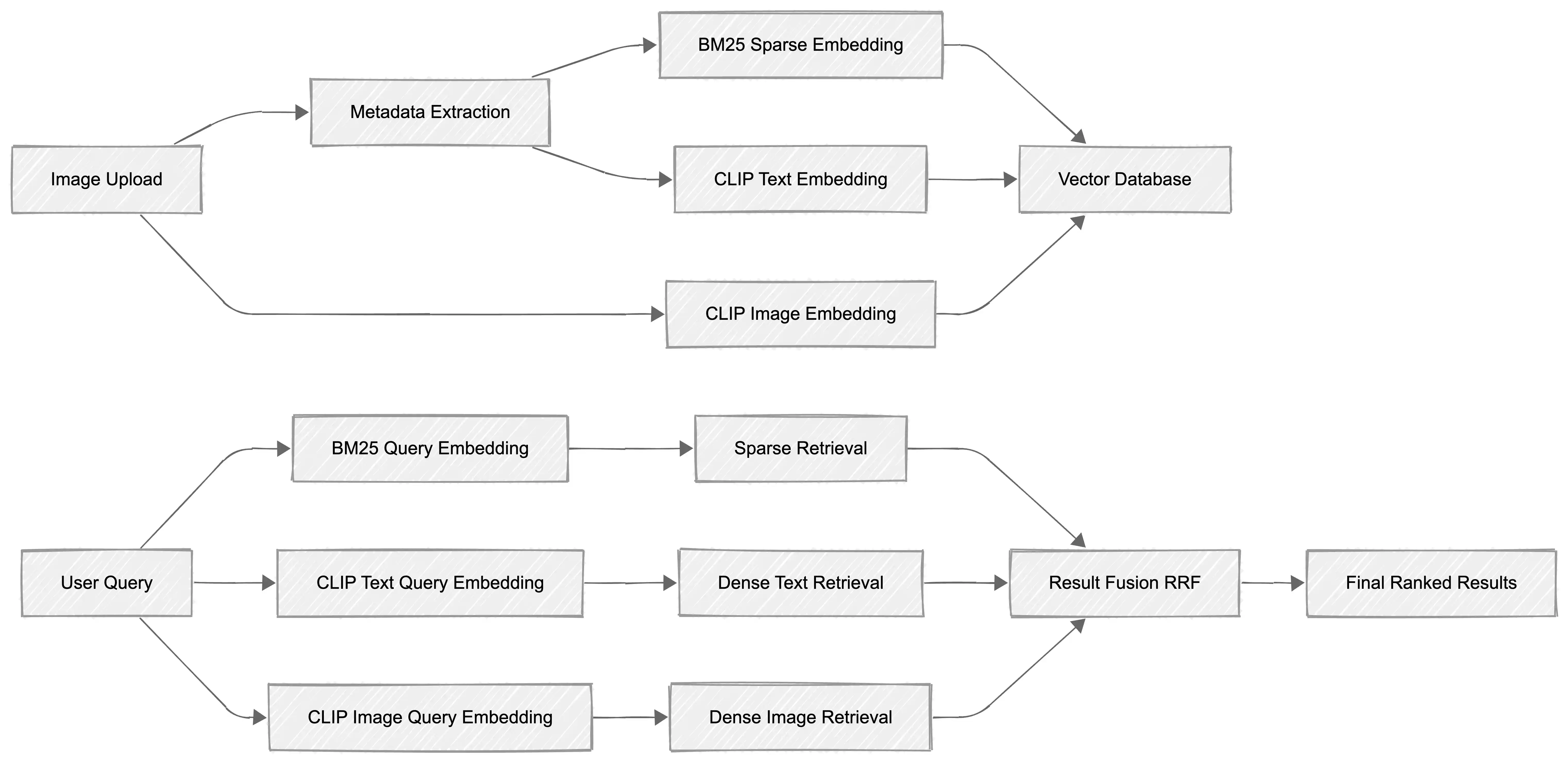
- Metadata Embedding
First, extract image metadata such as EXIF, title, and description, and embed them using:- BM25 to generate sparse vectors for keyword-level matching.
- OpenAI CLIP (text) to generate dense vectors for capturing semantic information and enabling fuzzy search.
- Visual Embedding
Use OpenAI CLIP (image) to embed the visual content, generating dense vectors that capture both visual and semantic information. - Vector Storage
All three vectors are upserted into the vector database, forming the foundation of retrieval. - Search and Result Fusion
During search, the user’s query is embedded in all three forms simultaneously. The results are merged using a weighted strategy and the RRF (Reciprocal Rank Fusion) algorithm, returning the most comprehensive and relevant output.
Multi-Layer Caching Design
Embedding models are computationally expensive, and vector retrieval introduces latency.
To minimize response time and ensure a smooth user experience, Pictures implements a three-layer Redis caching architecture.

Layer 1: Front-End Cache (Next.js)
When users visit the website, the front end first fetches homepage recommendations directly from Redis instead of making immediate backend calls.
This approach:
- Avoids high latency from serverless backend cold starts.
- Significantly reduces backend computation load.
Layer 2: Backend Cache (Service Layer)
The backend caches recommendation results so that identical or similar requests can be quickly served, improving throughput.
Layer 3: Embedding Cache (Embedding Layer)
Query embeddings are cached so that repeated queries reuse existing vectors instead of recomputing them, speeding up subsequent searches.
Distributed Architecture and Global Access
To ensure consistent, fast access for users worldwide, Pictures uses a distributed infrastructure:
- Image assets are hosted on Cloudflare R2, leveraging its global distributed storage and CDN network for fast image delivery.
- The website front end is deployed on Vercel, providing low-latency and scalable access through its CDN and Fluid Compute system.
Thanks to this architecture, Pictures serves users across the globe with stability and efficiency.